Inside Shipment 1519: two harbors, two ways to fight in Go Jače FPS
I've been giving two of Go Jače FPS's cargo-yard arenas a very different home. Shipment 1519 is a tight, lantern-lit harbor at night; Shipment 1519 Big opens that idea into an Adriatic-style waterfront district, with surrounding streets, elevated galleries and a warm sunset. Both revolve around enormous wooden cargo stacks, but the interesting difference is how you move around them.
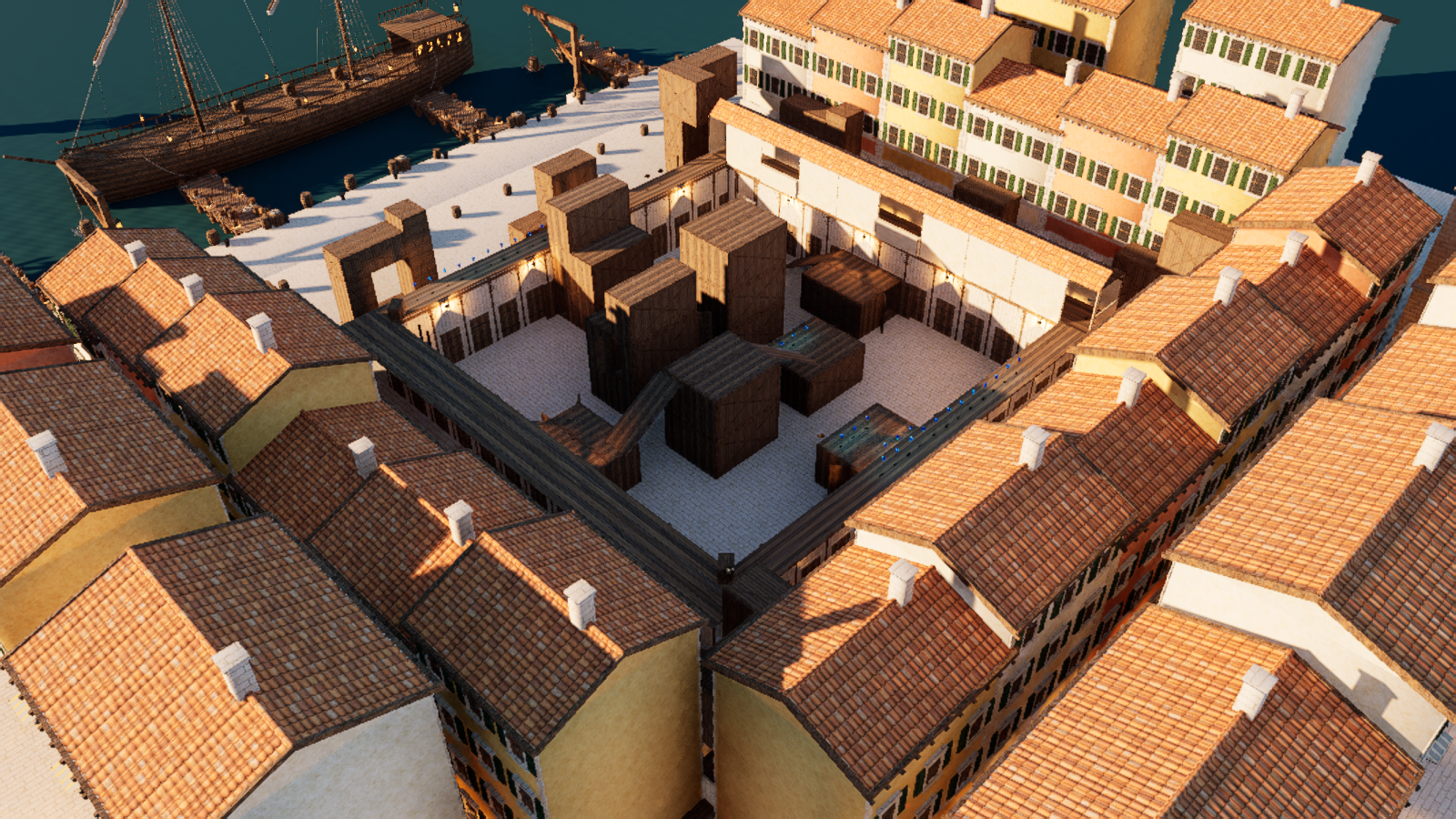
Shipment 1519 Big from an elevated development camera: the cargo courtyard sits inside galleries and waterfront buildings, with the galley beyond the arena boundary.
A shipping yard, five centuries out of place
The starting point is familiar arena geometry: solid blocks that break sightlines, gaps that become firing lanes, and ramps that turn the tops of those blocks into another route. The 1519 treatment gives that geometry a setting. Cargo becomes timber freight, perimeter walls become customs buildings, and the space beyond the arena becomes a port with stone quays, cranes, rope, barrels and a large galley.
It's a fictional, late-medieval maritime setting with an Adriatic and pirate-harbor flavour, not a reconstruction of a particular town in 1519. And this is still Go Jače FPS: glowing pickups and arena-shooter movement are quite deliberately sharing the scene with the old stonework.
The screenshots here are real engine captures from the September 9–10 map-polish and validation passes, including elevated development-camera views to make the layout readable. They aren't concept paintings. The small-map overview predates the final dock-lantern cleanup; the yard layout is unchanged, and the harbor close-ups show the later pass.
Shipment 1519: a small yard with a tall middle
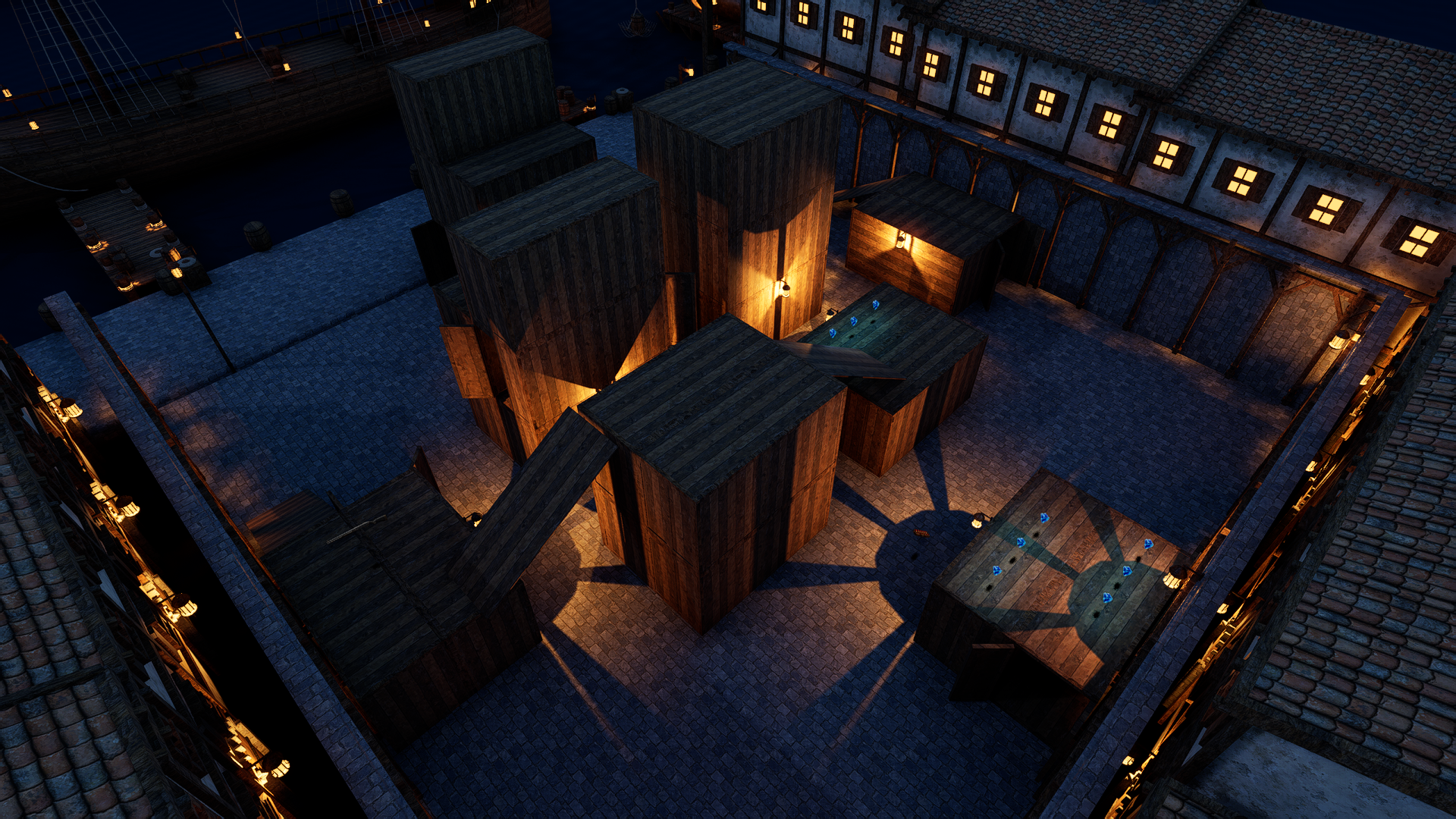
The compact night yard: ground lanes wrap around tall cargo stacks, while ramps connect lower platforms. This refinement-pass overview precedes the final dock-lantern cleanup.
Look down into the smaller map and the structure is easy to pick out. The cargo forms a dense central mass, with ground-level space around its edges and narrow cuts between the stacks. Ramp-connected platforms cross parts of that mass, while taller blocks interrupt the view even from above. Three built-up sides enclose the yard; the harbor-facing side opens visually toward the water.
At ground level, a stack can hide an opponent only a few steps away. Taking the outside lane gives you a longer view along the yard, but every opening back into the cargo is another angle to check. Cutting through the middle shortens the journey and adds corners. That is the trade-off I like in a compact arena: the route that gets you there quickly isn't necessarily the route that lets you see what you're walking into.
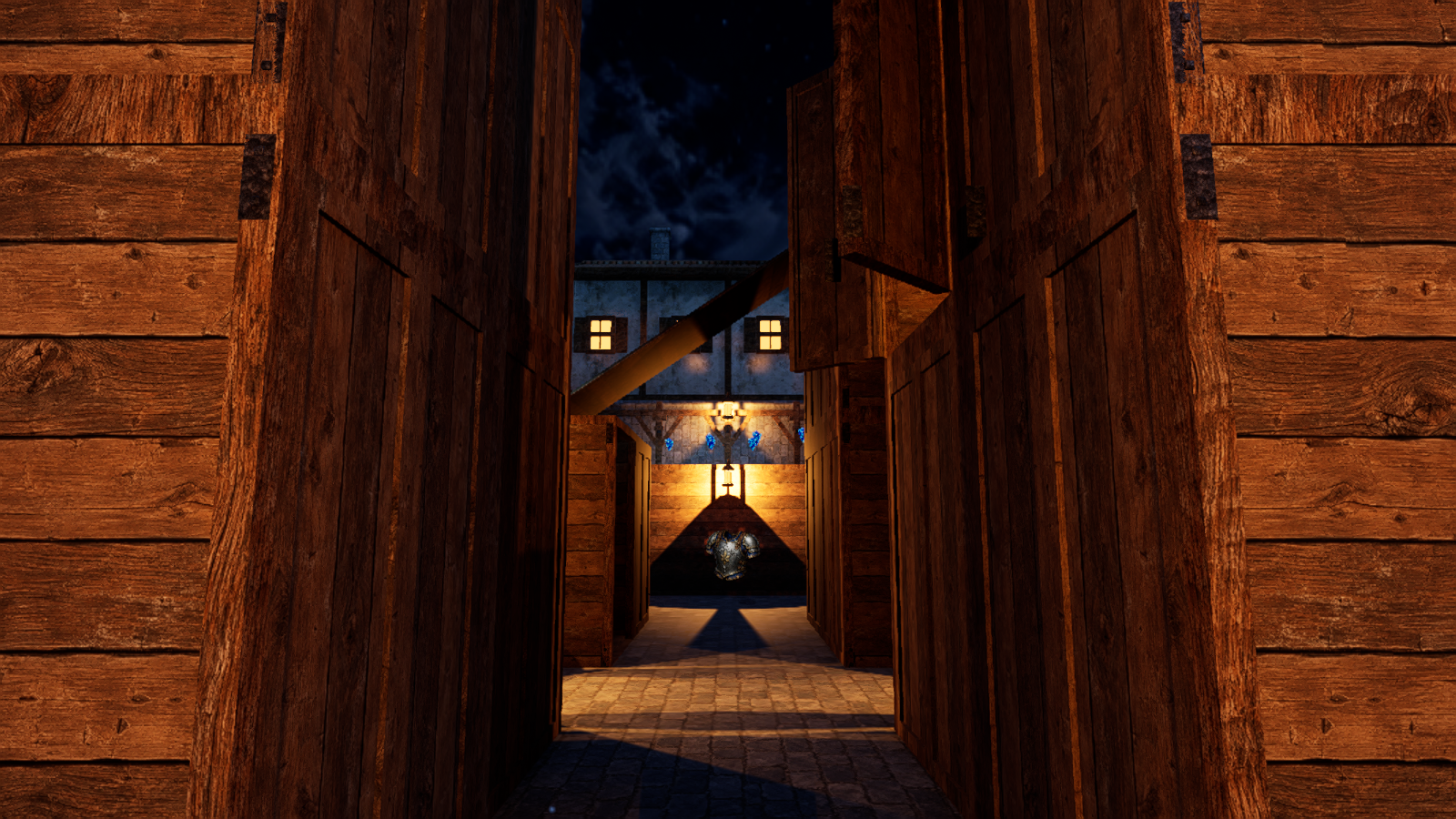
Down among the cargo, the small map becomes a series of narrow openings, interrupted sightlines and warm pools of lantern light.
The ramps add a second decision. Going up gives you views across lower cover and access to the pickup trails on the cargo, but it doesn't reveal the whole map. The highest stacks still block sightlines. You can look down on one lane while someone is moving around a block outside your view.
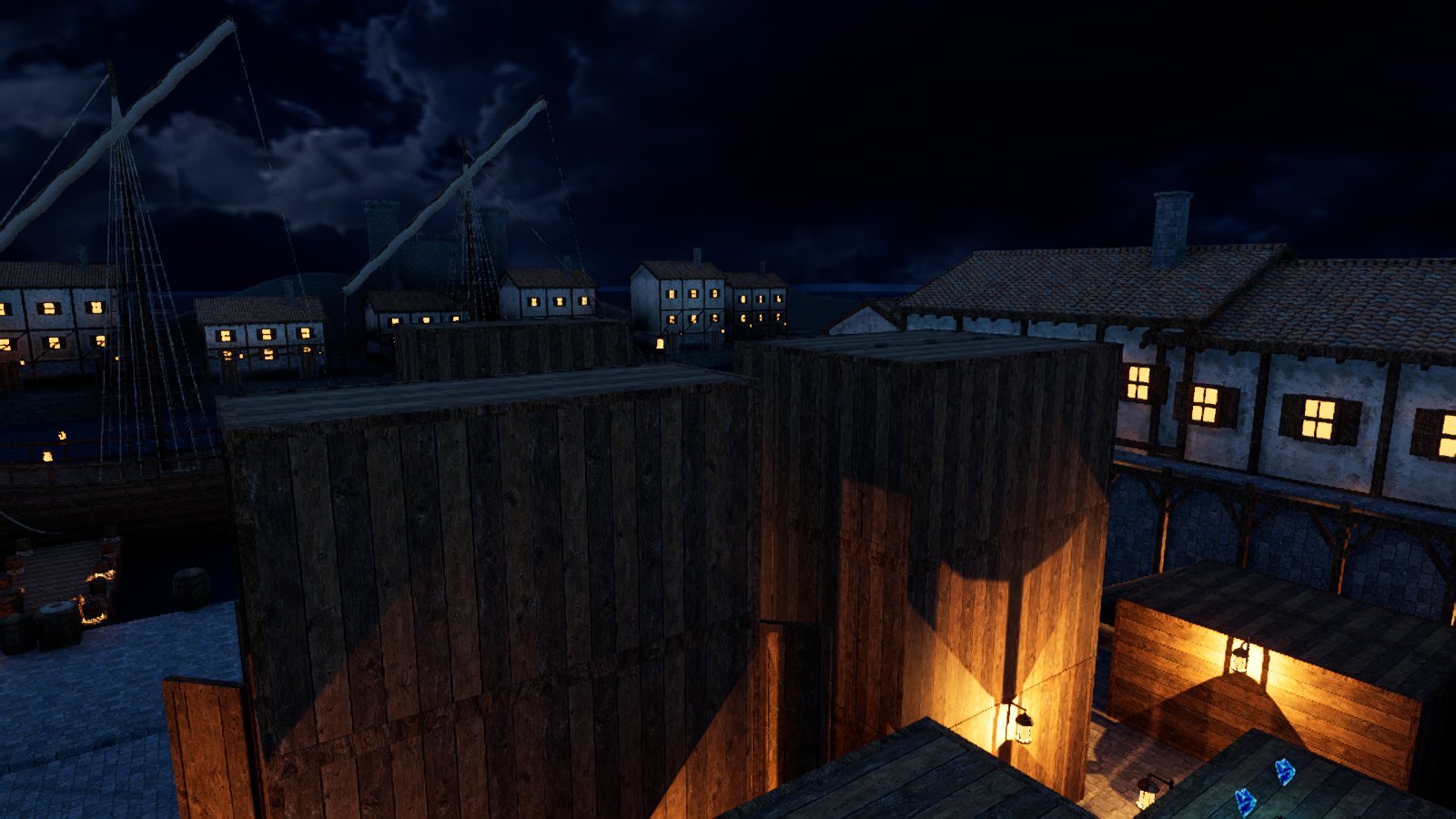
A view across the night map's upper cargo: gaining height opens some angles, but taller stacks still divide the view.
That makes height useful without turning the yard into one uninterrupted rooftop. My advice for learning the layout would be to walk the ground loop first, then follow each ramp and look back down at the entrances you just used. The same doorway feels quite different when you're approaching it from below rather than watching it from a platform.
Lantern light, dark water, and a harbor that answers back
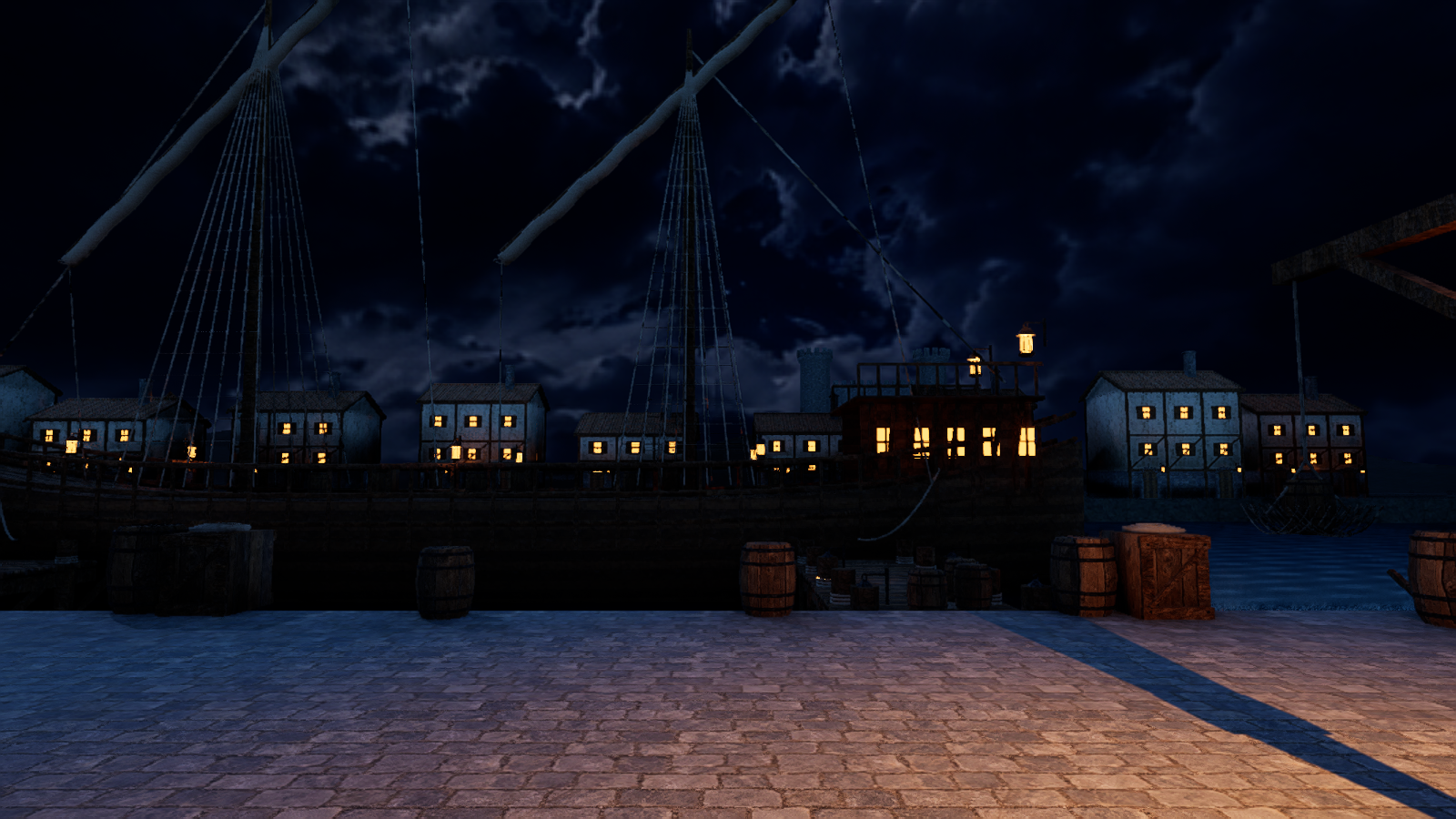
The small map's night setting is built around contrast. Cool blue light holds the larger shapes together, while lanterns and lit windows put warm patches on the timber and paving. Door frames, arches, roof tiles and wall brackets give the perimeter a scale beyond simply being a tall wall. The galley's masts and rigging make the open side recognisable even when most of the hull is in shadow.
The later harbor pass: stone paving, separate pier decks, dark water and the lantern-lit galley. The ship is background scenery, not a playable boarding area.
The boat is scenery, not a separate boarding level or a vehicle you can commandeer. Its gentle bobbing is cosmetic. The wider harbor gives the little yard somewhere to belong, but it does not turn the map into an open-world waterfront.
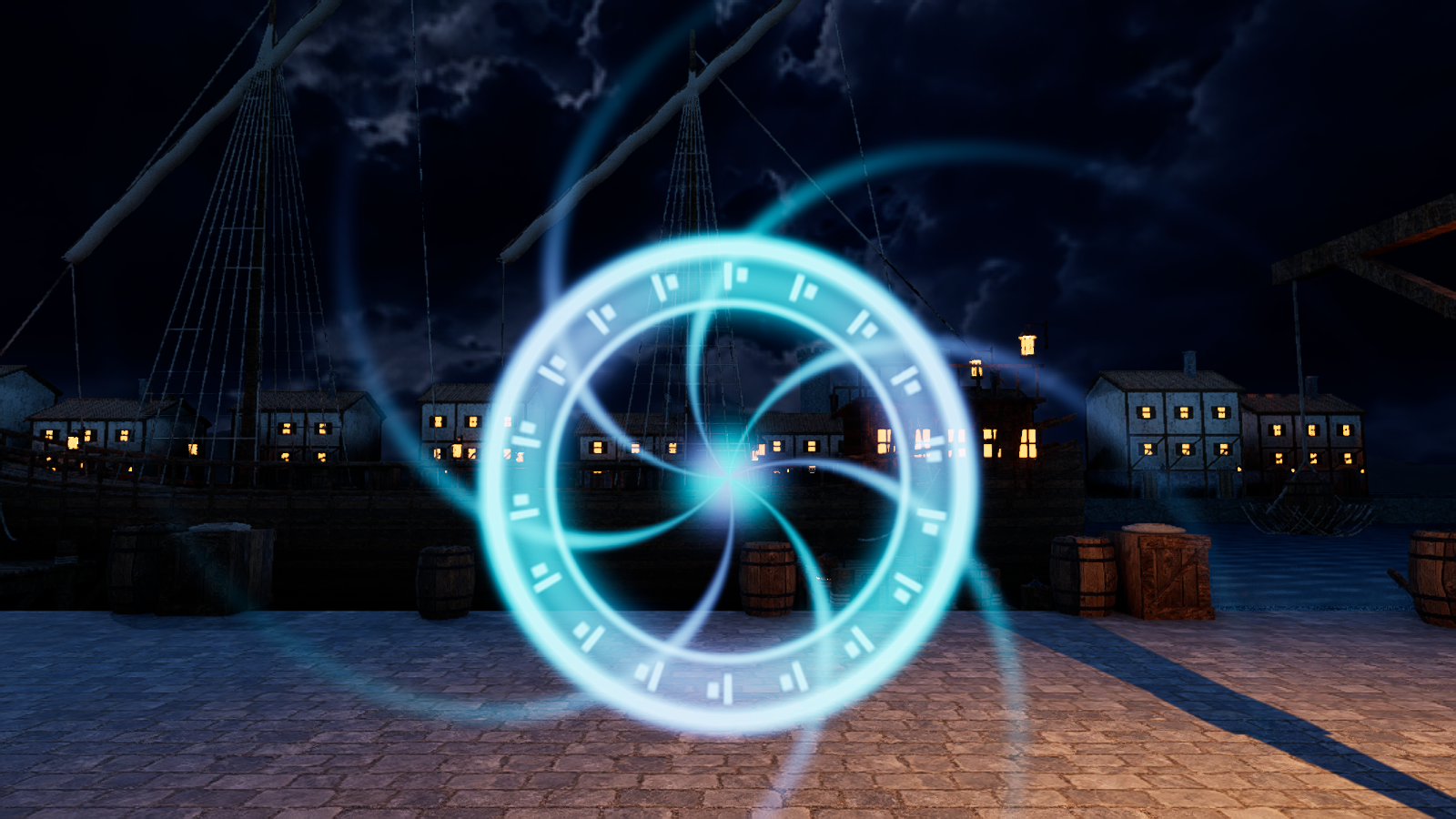
Keeping that distinction readable matters. The harbor boundary uses a reactive ward: shoot it, punch it or make contact with it, and a cyan-violet nautical sigil briefly blooms across the barrier before fading. The collision remains in place. This is feedback that you've reached the edge, not a shield you can destroy or a portal to another part of the map.
A shot makes the harbor ward visible as a brief cyan-violet sigil. The boundary remains solid; this is impact feedback, not a destructible barrier.
The latest small-map pass also gives the quay and four pier decks proper solid support, without filling the water gaps between them. If a player gets into the out-of-bounds harbor area, a server-owned RETURN TO THE YARD warning counts down from three. Returning cancels it; staying outside leads to an environmental death and the normal respawn. The message is deliberately simple: admire the waterfront, but the fight belongs in the yard.
Shipment 1519 Big: go around the fight, not just through it
Big is not the same arena uniformly stretched. It keeps the recognisable interior cargo courtyard, then gives it another layer of circulation: four surrounding streets, two ground passages between the inner and outer areas, and elevated galleries overlooking the action.
The useful mental picture is a yard inside a district. The middle still offers the short, interrupted encounters of the smaller map, but the surrounding streets let you change your approach instead of repeatedly committing to the same cargo gap. Those connections also concentrate movement: a passage between the outer route and the courtyard is somewhere you need to look before crossing, not just an architectural doorway.
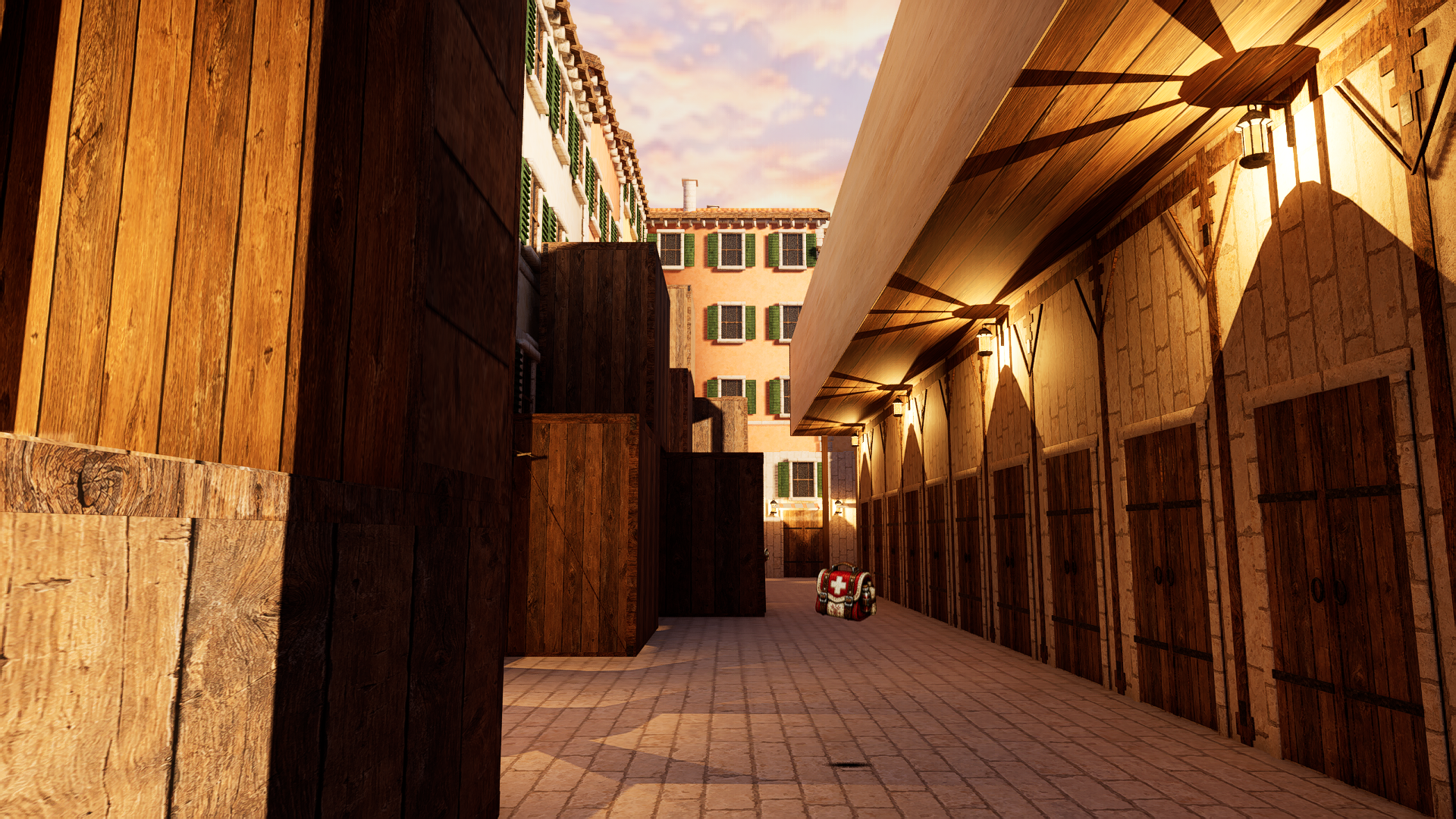
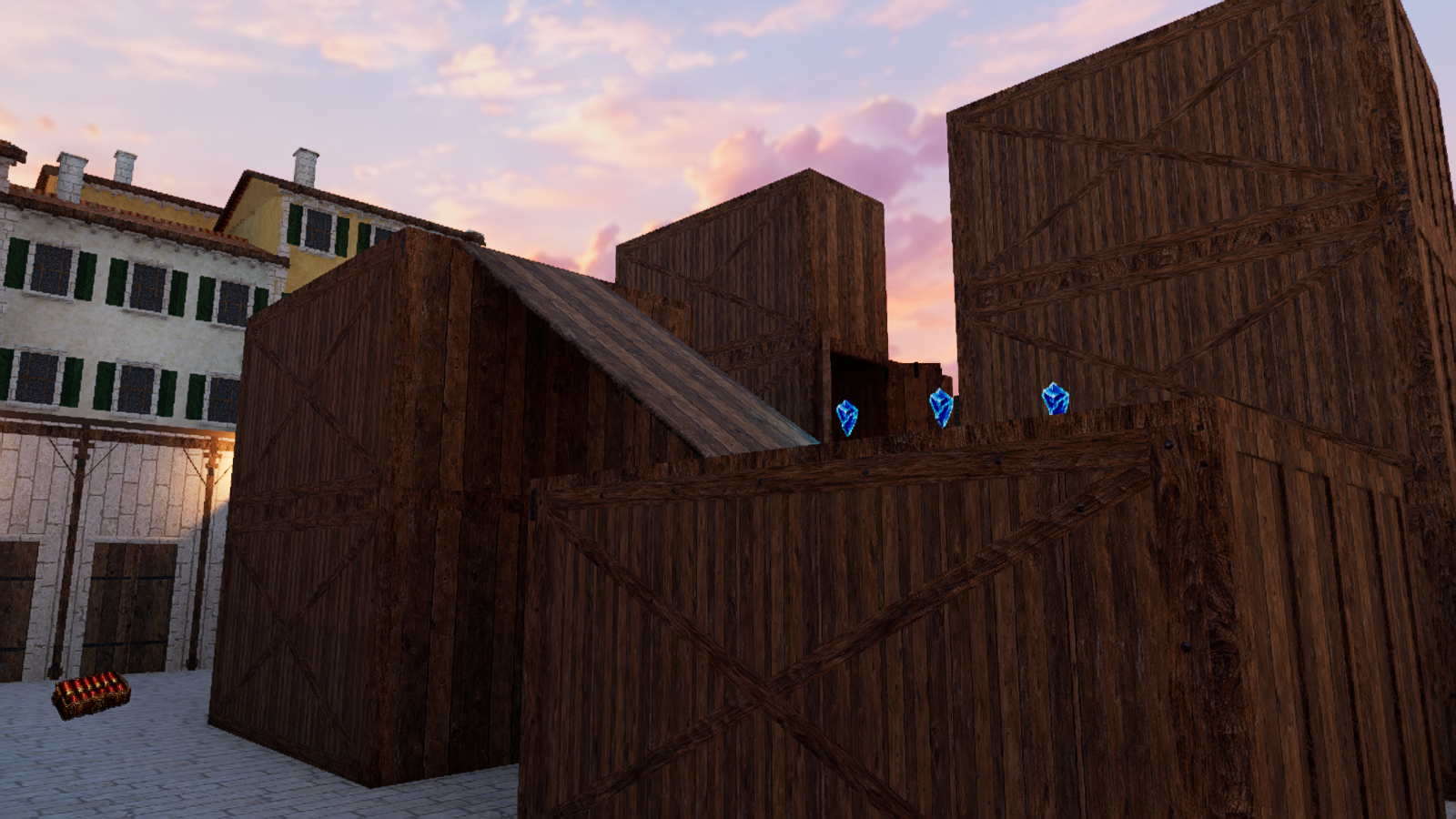
Big's eastern street during the sunset polish pass: cargo cover, loading doors and pickups form a route outside the courtyard. Later cargo-detail refinements are shown below.
The outer routes have their own cover and pickups. In layout terms, this gives a player reasons to leave the centre beyond simply running away from a fight. You can circle toward a different entrance, collect supplies, or come back at an angle. Whether that pays off depends on who controls the connecting routes; taking the long way round doesn't make you invisible.
Galleries, ladders and jump pads
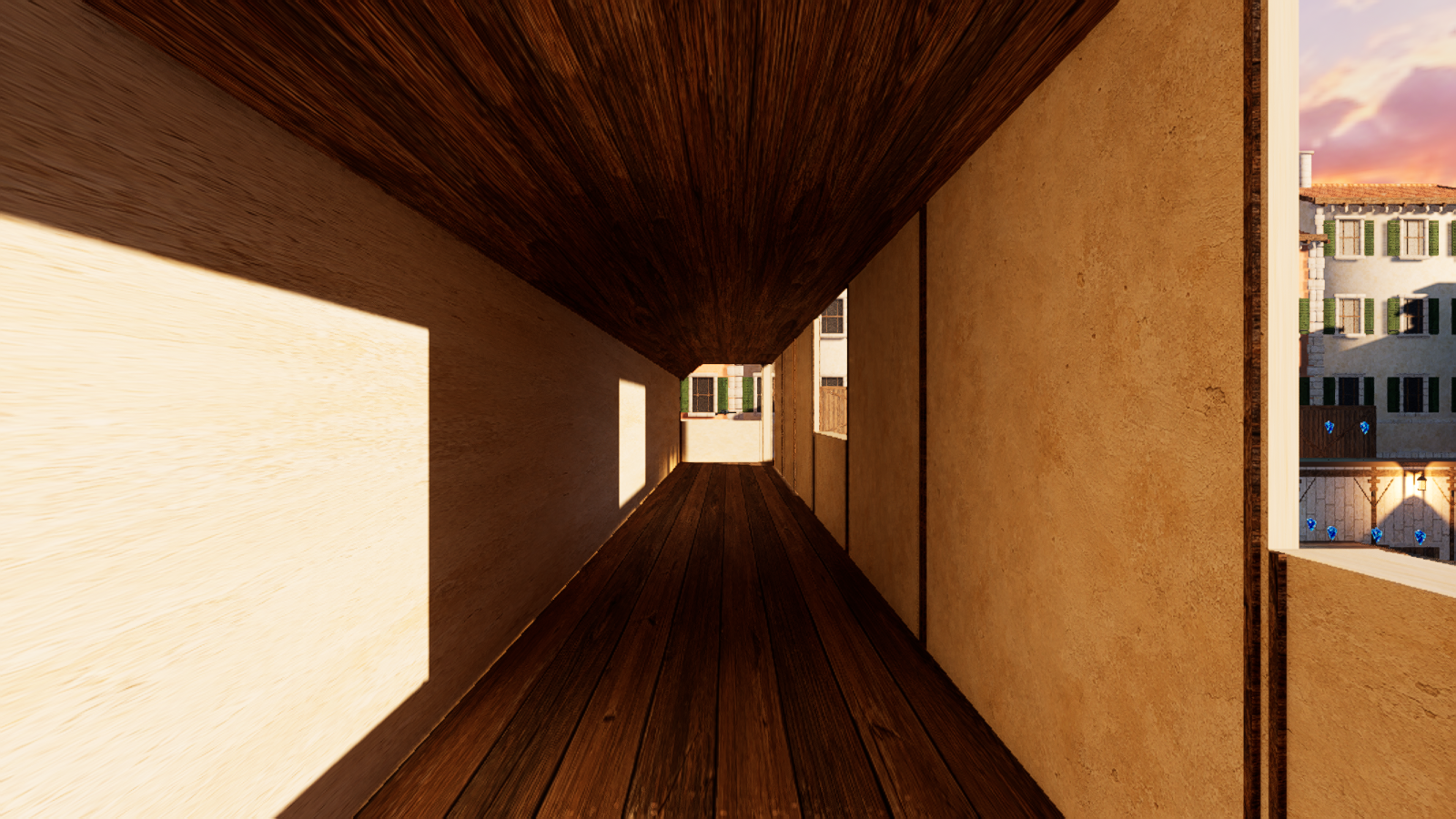
Big's upper level is more structured than the cargo-top paths below it. The eastern gallery is covered, while the other galleries remain open. The covered section reads as a long timber passage with repeated openings into the courtyard. Outside it, the open edges offer broader views and correspondingly more directions from which to be seen.
Inside the covered eastern gallery. Openings face the courtyard, while the timber passage creates a distinct upper-level route.
Two ladders and two jump pads connect the vertical routes. They are different ways to commit to an elevation change: a ladder follows a fixed climb, while a pad sends you onto a prescribed landing route. Recent refinements raised and centred the pad targets on the narrow galleries, and traversal checks covered ladder ascent, descent, re-entry and jumping off.
The central ramps still matter too. Big hasn't replaced the cargo-yard movement with a balcony-only game; it layers gallery access around it. From the courtyard, you're reading the gaps ahead and the edges above. From a gallery, you're watching the yard while keeping an eye on the route someone else could use to reach your level.
The central cargo remains playable terrain in Big: ramps, stacked platforms and visible pickup trails sit beneath the surrounding upper routes.
From night harbor to an Adriatic sunset
Big has a different mood before anyone fires a shot. Pale limestone and plaster, green shutters, terracotta roof tiles, striped awnings and warm evening light surround the yard. Secondary rooflines, chimneys and a bell tower extend the silhouette beyond the immediate combat walls. The turquoise water and galley carry the maritime theme across from the small map without repeating its blue-black night palette.
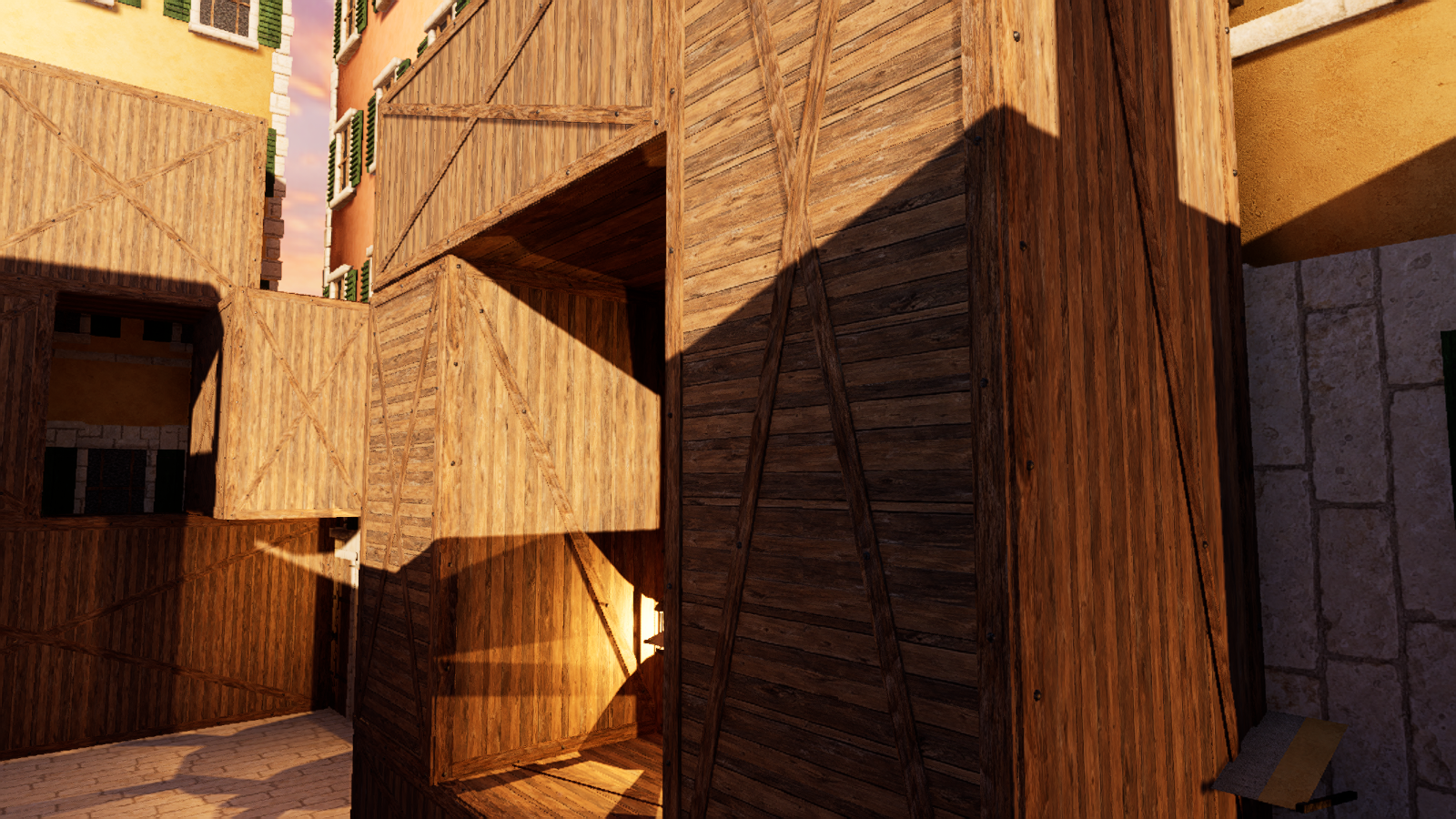
Up close, the cargo has been given plank divisions, timber frames, cross-bracing and iron fasteners. Wall joinery is present on both faces, so the view from an outer street isn't simply the unfinished back of the courtyard. It is still deliberately oversized arena cover, but now it looks assembled rather than merely textured.
The refined cargo up close: plank seams, timber framing, cross-braces and fasteners give the large cover blocks a constructed surface.
There is a practical constraint behind that detail: decorative trim should not quietly become a new obstacle. Most of the added scenery and fittings have no collision or navigation influence. The art pass preserved the established combat geometry and gameplay placements, with specific follow-up fixes for things such as a ramp foot meeting the ground properly. Big's harbor ward also covers both the lower boundary wall and the upper fence section, so reaching the edge upstairs gets the same visual explanation.
Which Shipment?
Feature
Shipment 1519
Shipment 1519 Big
Atmosphere
Night, cool harbor light and warm lanterns
Sunset, pale waterfront buildings and terracotta roofs
Main routes
Compact cargo yard, edge lanes and central cuts
Cargo courtyard, four surrounding streets and two ground passages
Vertical play
Ramps and cargo platforms
Cargo platforms plus galleries, two ladders and two jump pads
Current map-roster modes
Multiplayer and Horde
Multiplayer; Horde is disabled
Both currently default to four player slots. Neither is the dedicated Heroes Arena map: that mode has its own three-lane Sundered Sanctum arena.
For me, the appeal of the pair is that they share a vocabulary without asking exactly the same questions. Small makes a handful of corners, ramps and cargo stacks do a lot of work. Big asks you to connect that local fight to a street route or a position on the galleries. These remain development maps, with balance still something to judge by playing them. But they now have a proper place and mood: two working harbors, with rather more gunfire than the dockmaster probably expected.
If you'd like to support my game-development projects, support me on Patreon. Thank you!